
How to Describe a Snowy Owl: Sentence Templates & Writing Guide
✨ This article was AI edited. Editorial responsibility: School Essay Writer.
Describing a snowy owl’s appearance requires precise anatomical vocabulary that captures its dense plumage, camouflaged chevron markings, luminous golden-yellow irises, and silent predatory posture. Whether composing a single evocative sentence or a full naturalistic essay, writers use sensory metaphors of frost, alabaster, and arctic stillness to depict this iconic avian predator.
The snowy owl (Bubo scandiacus) is one of the most visually arresting apex predators of the Arctic tundra. Unlike nocturnal woodland owls, the snowy owl hunts by daylight across vast, treeless landscapes, endowed with specialized adaptations that allow it to endure temperatures dropping below minus fifty degrees. Depicting a snowy owl on the page requires moving beyond the generic descriptor ‘white bird’ to explore the delicate gradations of ivory plumage, feathered talons, and hypnotic facial discs.
Contents
- Anatomical & Visual Profile of the Snowy Owl
- How to Describe a Snowy Owl in a Single Sentence: 10 Formulaic Templates
- Descriptive Model Essay: The Ghost of the Barren Ground (600 Words)
- Frequently Asked Questions (FAQ)
- Comparative Avian Profile: Snowy Owl vs. Great Horned Owl & Barn Owl
- Literary & Mythological Symbolism of the Snowy Owl
Anatomical & Visual Profile of the Snowy Owl
To accurately describe a snowy owl in academic or creative writing, reference its core physical characteristics:
| Anatomical Feature | Physical Adaptation & Characteristics | Evocative Lexicon & Metaphors | Descriptive Writing In Action |
|---|---|---|---|
| Plumage & Coloration | Dense, multi-layered down; pristine white in mature males, brown-barred chevrons in females and juveniles | Alabaster down, speckled chevron markings, ermine mantle, frosted ermine, dewy porcelain | Her wings were an expanse of layered alabaster, delicately barred with charcoal chevrons resembling ripples across windblown snow. |
| Facial Disc & Eyes | Concave parabolic feathers directing sound; large forward-facing luminous amber-yellow eyes with black pupils | Piercing sulfur irises, obsidian pupils, parabolic facial disc, hooded stare, predatory gaze | Two round sulfur-yellow eyes stared out with unblinking intensity, burning like twin lanterns against a mask of pure white down. |
| Beak & Talons | Hooked black bill obscured by bristling facial feathers; thick feathered feet with razor-sharp black talons | Concealed obsidian beak, woolly plumage, dagger talons, cushioned paws, frost-covered perches | Feathered boots extended down to her razor-sharp talons, completely cloaking the black curved daggers in thick, thermal insulation. |
| Flight & Silhouette | Broad rounded wings with comb-like leading serrations for silent flight; barrel-shaped posture | Buoyant glide, ghostly silhouette, silent aerial phantom, barrel-chested sentinel, acoustic silence | It launched into the arctic dusk without a whisper of displaced air, gliding like a living crest of drifting snow across the tundra. |
How to Describe a Snowy Owl in a Single Sentence: 10 Formulaic Templates
When you need a punchy, highly visual single sentence for an essay, caption, or narrative scene, use these structural templates:
1. The Sentinel Template (Stillness & Eyes):
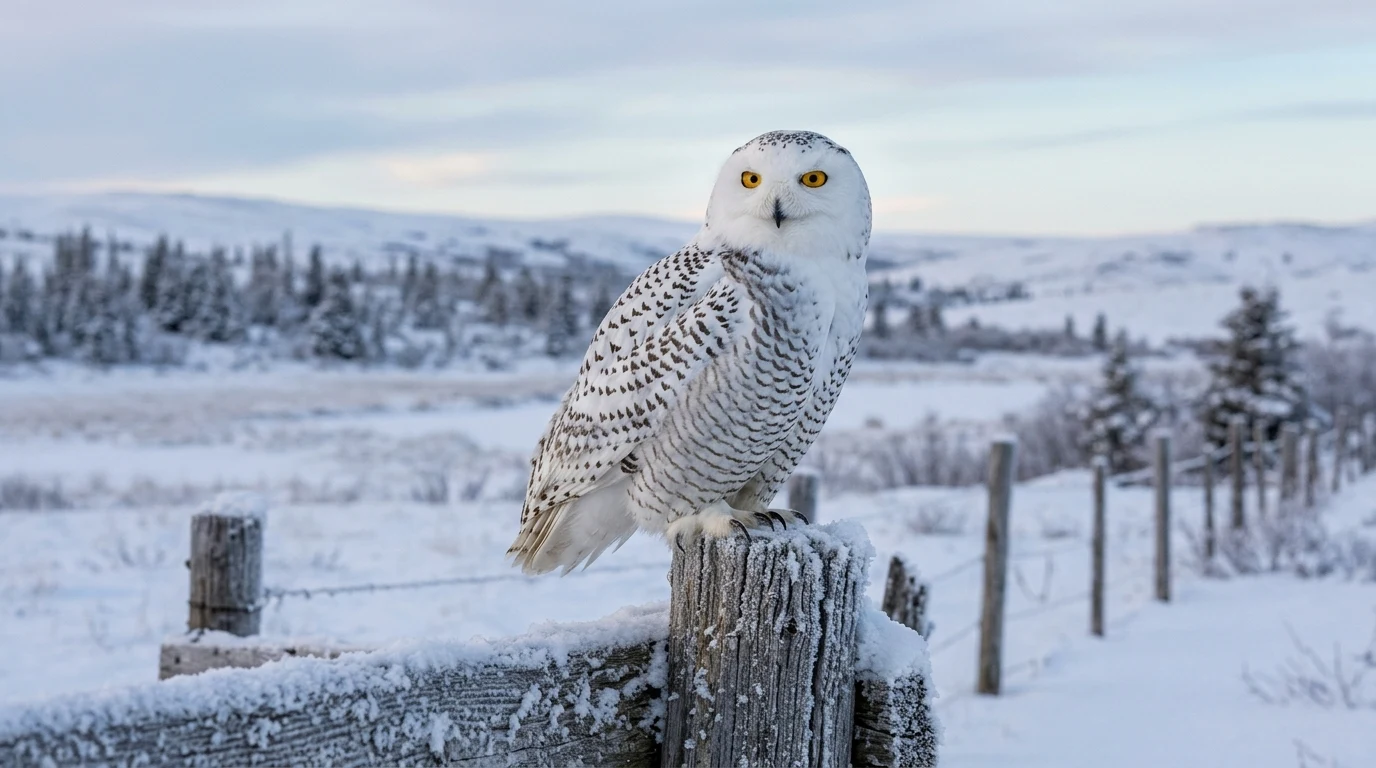
“Perched atop the frost-encrusted fence post, the snowy owl stood like a carved alabaster sentinel, its brilliant sulfur-yellow eyes surveying the frozen tundra with hypnotic stillness.”
2. The Camouflage Template (Landscape Integration):
“So immaculate was its snow-white plumage that the owl dissolved entirely into the arctic expanse, betraying its presence only by the sudden, deliberate blink of amber irises.”
3. The Aerial Motion Template (Silent Flight):
“With a five-foot wingspan of feathered ivory, the snowy owl drifted over the icy ridges like a silent cloud of displaced frost, vanishing and reappearing across the pale horizon.”
4. The Female Chevron Template (Pattern & Texture):
“Dusted with rhythmic flecks of charcoal across her broad wings, the female snowy owl presented a majestic tapestry of frost and shadow against the winter sky.”
5. The Close-Up Portrait Template (Facial Focus):
“Framed by a dense, dish-shaped face of downy feathers, the owl’s hooked black bill remained almost entirely hidden behind a dense mustache of protective white bristles.”
Descriptive Model Essay: The Ghost of the Barren Ground (600 Words)
Across the wind-scoured plains of the northern tundra, the world was an unbroken monotony of white and slate-gray. In this frozen expanse, stillness was not merely an absence of sound—it was a survival strategy. High upon a weathered boulder of glacial granite, the snowy owl sat motionless, its barrel-chested form anchored firmly against the biting northerly wind.
Every fiber of the creature’s physiology spoke to evolutionary perfection. Its plumage was a marvel of biological insulation: thick, velvety down trapped a layer of warm air against the skin, covered by stiff contour feathers that formed an impenetrable windproof shell. In the afternoon light, its white feathers held the subtle, pearlescent glow of newly fallen powder. Small, rhythmic chevrons of dark sepia marked the tips of its flight feathers, identifying it as a young female.
Suddenly, the owl rotated its head—a smooth, frictionless turn of nearly two hundred and seventy degrees. Its large, forward-facing eyes, bordered by black feather margins, captured every photon of low winter sunlight. The irises were the color of liquid amber, blazing with predatory intelligence. Without shifting its feet, it calculated the subterranean movements of a lemming beneath fourteen inches of crusted snow.
With a sudden, effortless heave of its broad shoulders, the owl pushed off from the granite ledge. There was no whistling rush of air, no frantic flapping of wings. The specialized serrations on the leading edge of its primary feathers broke the air turbulence into silent micro-currents. It was a ghost on the wing—a majestic synthesis of power, silence, and beauty reigning over the frozen rooftop of the earth.
Frequently Asked Questions (FAQ)
- Why are some snowy owls completely white while others have dark spots?
- Adult males are almost pure white to camouflage on open snowfields, whereas females and juveniles retain brownish-black barred markings (chevrons) for camouflage while nesting on the ground.
- What is the best metaphor for a snowy owl’s eyes?
- Common evocative metaphors include ‘amber lanterns,’ ‘sulfur coals,’ ‘golden coins,’ or ‘twin topaz beacons against a winter canvas.’
Comparative Avian Profile: Snowy Owl vs. Great Horned Owl & Barn Owl
To accurately highlight the unique majesty of the snowy owl, compare its specific adaptations against other prominent owl species:
| Species | Primary Habitat | Plumage & Camouflage | Hunting Behavior & Adaptation |
|---|---|---|---|
| Snowy Owl (Bubo scandiacus) | Arctic tundra, open plains, coastal dunes | Pure white or chevron-barred alabaster; heavily feathered talons for sub-zero survival | Diurnal and crepuscular; visual and acoustic hunting over vast treeless landscapes |
| Great Horned Owl (Bubo virginianus) | Deciduous forests, deserts, urban parks | Mottled brown, gray, and buff; prominent ear tufts and white throat bib | Strictly nocturnal; powerful apex ambush predator in dense forest canopies |
| Barn Owl (Tyto alba) | Farmland, open grasslands, historic barns | Heart-shaped facial disc, golden-buff back with delicate black and white spots | Nocturnal rodent hunter; extreme acoustic precision using asymmetrical ear openings |
Literary & Mythological Symbolism of the Snowy Owl
Throughout Inuit mythology and modern literature, the snowy owl occupies a revered place as a spirit of wisdom, patience, and unyielding endurance:
- The Keeper of the Arctic Winds (Inuit Lore): In Northern folklore, the snowy owl (Ukpik) is viewed as a sacred protector capable of navigating the darkest polar nights without losing its way.
- Modern Literary Motifs: In contemporary coming-of-age and fantasy fiction, the snowy owl symbolizes purity of intention, quiet independence, and extraordinary clarity of vision in chaotic times.
- Metaphorical Utility for Essays: Writers frequently evoke the snowy owl to represent stoic resilience—standing calm, unbothered, and keenly observant amid life’s harshest blizzards.
Get our latest guides, news, and insights highlighted in your Google Search & AI Overviews.


