
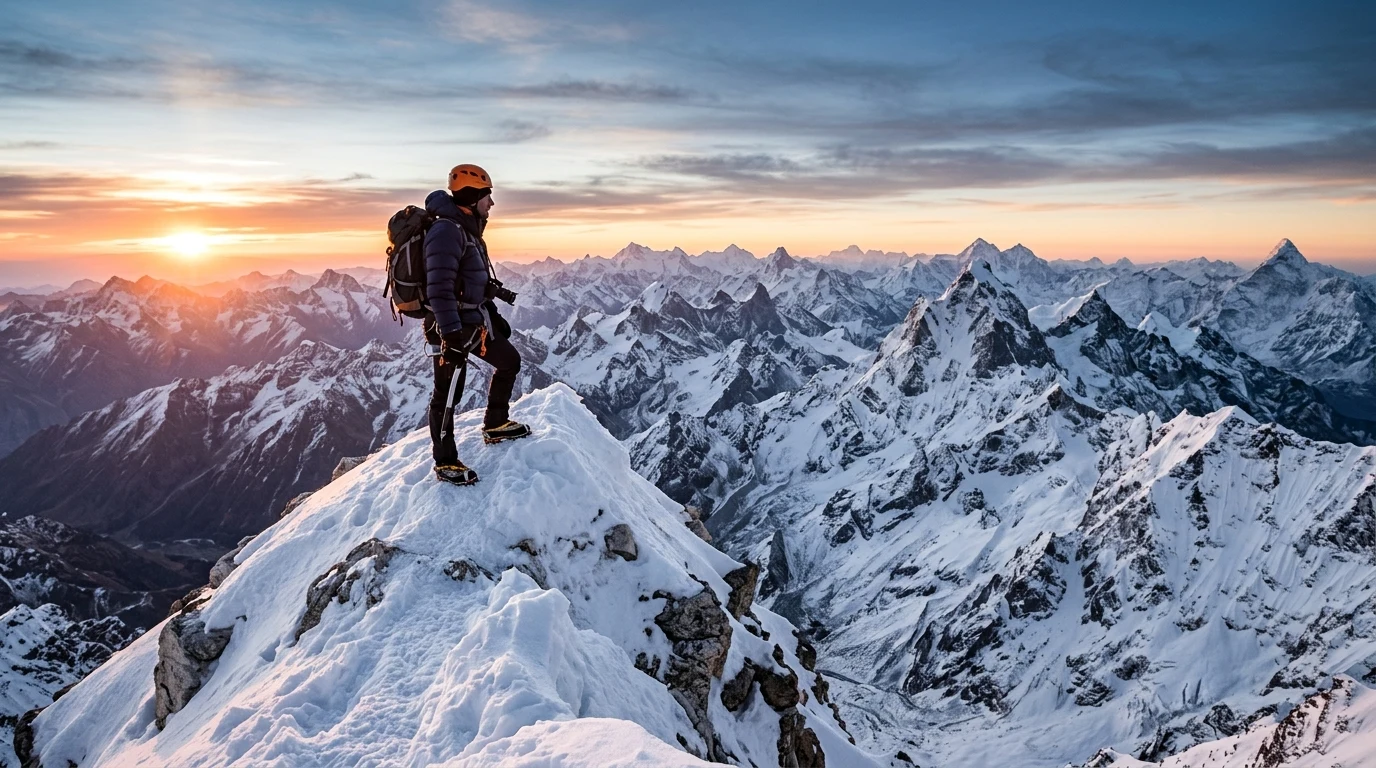
Descriptive Essay on Standing on a Snowy Mountain: Writing Guide
✨ This article was AI edited. Editorial responsibility: School Essay Writer.
Writing a descriptive essay on standing on a snowy mountain requires capturing the sensory extremes of alpine isolation, razor-sharp glacial winds, blinding light reflections, and the profound psychological clarity of reaching a high summit. By contrasting the grueling physical ascent with the serene stillness of the peak, writers create compelling narratives of human resilience and natural transcendence.
High alpine peaks represent the ultimate crucible of physical endurance and spiritual contemplation. Standing on a snow-draped mountain summit at eleven thousand feet, the world below is reduced to miniature topography, while the sky above assumes a deep, oceanic cobalt blue rarely witnessed from sea level. Capturing this experience in prose demands a masterful balance between atmospheric description, physiological sensations of exertion and cold, and the philosophical introspection that naturally accompanies high-altitude solitude.
Contents
The Sensory Architecture of an Alpine Summit
To build an authentic mountain setting, engage all five senses with specialized high-altitude vocabulary:
| Sensory Dimension | High-Altitude Environmental Realities | Evocative Lexicon Bank | Descriptive Writing Example |
|---|---|---|---|
| Sight & Horizon | Glacial seracs, crevasses, jagged ridge lines, sea of clouds, alpenglow | Chiseled granite, pristine snowfields, serrated ridges, azure abyss, blazing alpenglow | To the north, a endless labyrinth of razor-backed peaks pierced the cloud deck like the white teeth of a submerged dragon. |
| Sound & Atmosphere | Whistling wind, crunch of crampons on hard ice, muffled stillness, breathing | Howling gale, rhythmic scrape of steel spikes, hollow roar, vacuum stillness, gasping breath | When the wind momentarily ceased, the silence was staggering—a total, acoustic vacuum broken only by the rhythmic hammer of my pulse. |
| Tactile & Temperature | Sub-zero temperatures, burning lungs, numb fingertips, coarse snow crystals | Biting frost, razor-sharp draft, burning thighs, wind-scoured ice, dry heat of exertion | The air felt thin and dry as powdered chalk, searing my bronchial passages with every ragged, greedy breath. |
| Smell & Respiration | Frozen ozone, clean mineral stone, damp wool, absence of vegetative scents | Crisp ozone, frozen granite, mineral purity, cold sterile void | High above the tree line, there was no scent of soil or pine—only the stark, electric smell of pure ozone and sun-bleached snow. |
| Taste & Thirst | Dry metallic air, melted snow water, sugary energy gel, mineral salt | Icy numbness, metallic tang, syrupy sweetness, dry tongue | The icy water from my insulated flask tasted sharp and sweet, melting against the parched roof of my mouth. |
Chronological Narrative Cadence: The Summit Journey
Structure your descriptive mountain essay around the classic three-part ascent structure:
- The Pre-Dawn Push (The Crucible of Effort): The rhythmic crunch of boots in headlamp beams, the intense cold, the steepness of the switchbacks, and the mental battle against physical fatigue.
- The Summit Breakthrough (The Climax of Horizon): Stepping onto the final ridgeline, the sudden explosion of 360-degree sunlight, the unveiling of distant valleys, and the overwhelming emotional release.
- The Contemplative Descent (The Transformed Perspective): Looking back at the summit from below, realizing how the mountain permanently altered your internal sense of scale, humility, and ambition.
Model Essay: Above the Sea of Clouds (800 Words)
I. The Final Ridge
For four agonizing hours, my world had been reduced to an eighteen-inch circle of yellow light cast by my headlamp on wind-packed crust. Each upward step demanded a deliberate negotiation with gravity: kick the steel front-points of the crampons into the ice, drive the adze of the ice axe into the snowpack, exhale a plume of crystallized steam, and repeat. The wind roared over the col with the freight-train fury of an arctic front, tearing loose plumes of spindrift that stung my exposed cheeks like shattered glass.
My thighs burned with lactic acid, and my lungs screamed for oxygen in the thin, brittle atmosphere. Every instinct in my body begged to turn back toward the warmth of the lower basecamp huts. Yet with every upward heave, the pitch of the slope eased, until suddenly, there was nowhere left to climb.
II. The Summit Sanctuary
I took one final step and found myself standing on a knife-edge platform of pristine, wind-carved snow. In an instant, the grueling physical agony dissolved into profound, breathless awe.
Below me, an unbroken ocean of white stratus clouds blanketed the valleys from horizon to horizon, glowing like molten gold under the first rays of the morning sun. High above the cloud deck, isolated granite summits punctured the mist like solitary islands in an arctic sea. The sky above was not the familiar pale blue of the plains; at twelve thousand feet, it was an intense, ink-stained cobalt, bordering on the velvet black of outer space.
The wind dropped to a gentle whisper. In that sudden stillness, the scale of the landscape was humbling. Cities, borders, anxieties, and deadlines were buried under miles of impenetrable cloud. Up here, on this ancient pyramid of granite and ice, time operated on a geological clock. The mountain did not care about human triumph; it simply existed, magnificent and indifferent, standing as a timeless testament to the beauty of the wild earth.
III. The Descent of the Mind
As I finally turned to begin the long descent back toward the valley, I looked over my shoulder at the summit cross fading into the midday glare. I had not conquered the mountain; one never conquers nature. Rather, the mountain had conquered my doubts, stripping away trivial distractions and leaving behind an enduring reservoir of quiet, unshakable clarity.
Frequently Asked Questions (FAQ)
- How do I describe altitude sickness or thin air in an essay?
- Describe the sensation of taking full, deep breaths that feel strangely empty, a light drumming pressure behind the temples, and the rapid pounding of the heart during ordinary movements.
- What is alpenglow in mountain descriptions?
- Alpenglow is the reddish or golden-pink illumination seen on mountain summits just before sunrise or immediately after sunset when the sun is below the horizon.
The Philosophy of High-Altitude Solitude: Sublime vs. Beautiful
In literary aesthetics, mountain landscapes are categorized using the philosophical concept of The Sublime:
| Aesthetic Concept | Definition & Psychological Experience | Descriptive Writing Application |
|---|---|---|
| The Beautiful | Harmonious, gentle, pleasing to the senses (e.g., a quiet meadow flower) | Soft sunlight, gentle snowflakes falling on pine needles, pastel pink dawn skies. |
| The Sublime | Awe-inspiring, terrifying, vast, indifferent to human life (e.g., a 2,000-foot glacial abyss) | Towering granite headwalls, yawning crevasses, thunderous avalanche rumbles in the distance. |
Field Guide to High-Altitude Mountaineering Lexicon
- Bergschrund: A deep crevasse where moving glacier ice separates from stagnant ice on the headwall.
- Cornice: An overhanging edge of snow on a ridge crest formed by wind drifts.
- Spindrift: Fine, powdery snow blown in swirling clouds off mountain crests by gale-force winds.
- Scree & Talus: Loose, broken rock debris accumulating at the base of steep mountain slopes.
Get our latest guides, news, and insights highlighted in your Google Search & AI Overviews.


